This weekend, while most of us were enjoying the bank holiday, Ireland quietly switched on its AI regulator.
The AI Office of Ireland (Oifig IS na hÉireann, if you want the full title) became operational on 2 August 2026. It was created under the Regulation of Artificial Intelligence Act 2026, signed into law in July, and it now coordinates how the EU AI Act is enforced here. Paul Byrne has been appointed as its first CEO.
If you’ve seen the headlines, you’ve probably also seen the scary takes. Fines of millions. Compliance nightmares. AI crackdowns.
Here’s the thing: for most Irish SMEs, the reality is far more manageable than the headlines suggest. Let me walk you through what actually changed, what applies to you, and what to do about it.
What actually happened
Three things, in plain English:
- Ireland now has a central AI authority. The AI Office coordinates 15 existing regulators (the Data Protection Commission, the Central Bank, Coimisiún na Meán and others). You don’t get a new regulator. Your existing one just gained AI powers.
- New transparency rules kicked in on 2 August. These apply to certain AI systems and certain kinds of content, not to everything AI touches. The common one for small businesses: if people are interacting directly with an AI system, such as a chatbot on your website, they should be told. Some categories of generated or manipulated content need labelling too. Whether that applies to you depends on what you are publishing and how.
- Enforcement is now real, but it starts gently. The Office’s compulsory information powers don’t kick in until December 2026. Before that, the emphasis is on guidance and engagement rather than penalties.
That last point matters more than anything else in this post. There is a window here, and it rewards businesses who get organised early rather than waiting to be asked. The door is wide open. You just have to walk through it.
What it means for you: the 5-point checklist
If you run an Irish SME using everyday AI tools (ChatGPT, Copilot, a website chatbot, AI in your accounting software), here’s your actual to-do list.
1. Know what AI you’re using. Most business owners I work with underestimate this by half. Staff are using ChatGPT on personal accounts. There’s AI built into tools you already pay for. Make a simple list: what’s in use, who uses it, what data goes into it. One page is enough to start.
2. Train your team. This one surprises people. Article 4 of the EU AI Act requires every organisation deploying AI to make sure staff have adequate AI literacy, and it has been in force since February 2025. It applies to a 5-person clinic the same as it applies to Google. The good news: for a small business, this is a practical training session and a record that it happened, not a legal project.
3. Add your AI disclosures. If customers interact with your AI, tell them. A clear line on your chatbot (“You’re chatting with our AI assistant”) covers most SME cases. Same principle for AI-generated content where the rules require it. This costs you an afternoon, not a consultant’s retainer.
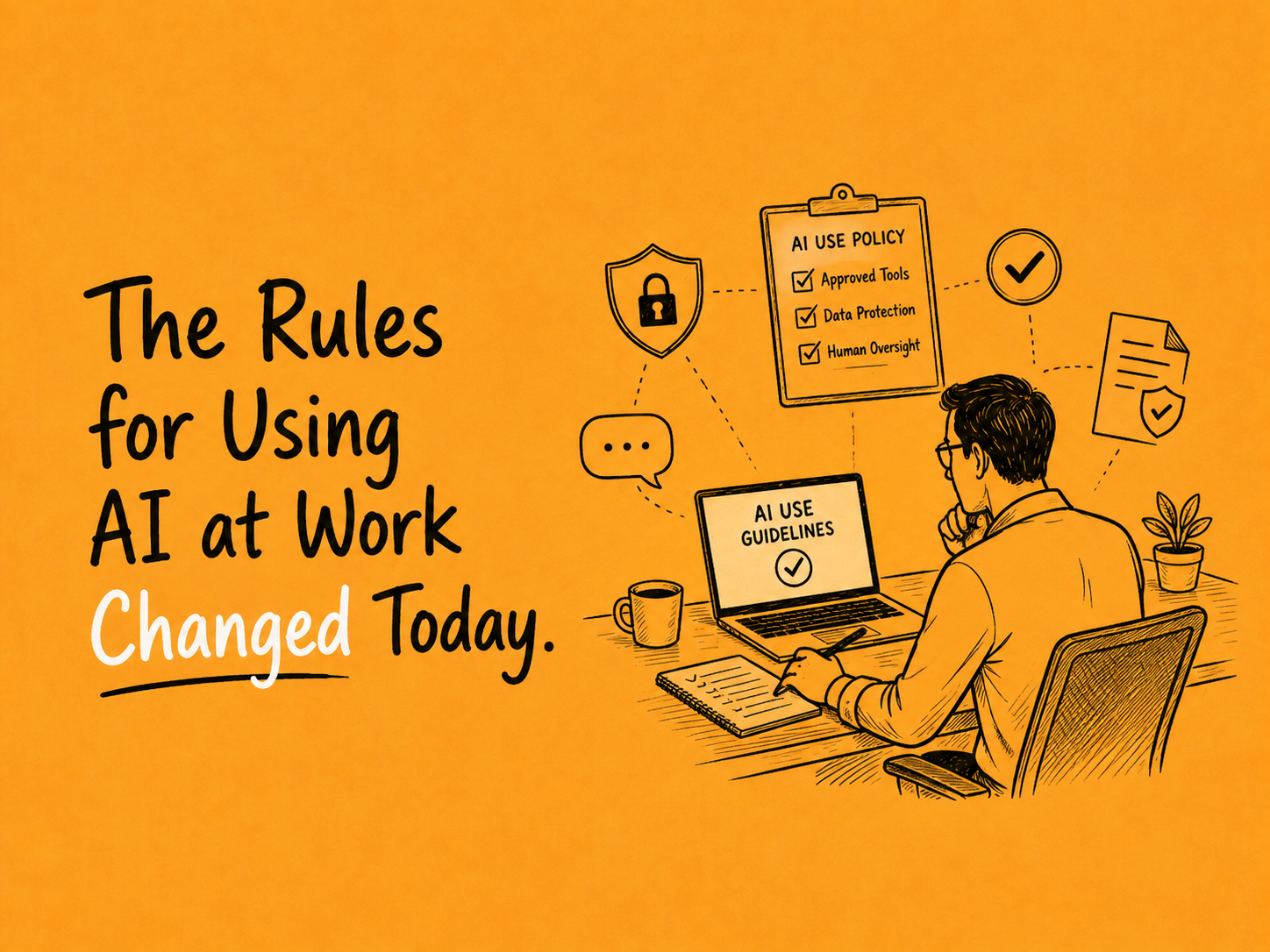
4. Write down your rules. An AI usage policy doesn’t need to be 40 pages. One or two pages covering what tools are approved, what data never goes into them, and who to ask when unsure. Your team will actually read it, and it becomes your first piece of evidence that you take this seriously.
5. Keep a simple record. Your tool list, your policy, your training record, your disclosures. One folder. That’s your governance pack. If a client, a regulator or a tender ever asks how you manage AI, you open the folder instead of opening a panic.
What you can stop worrying about
- The headline fines. The maximum penalties you’ve read about are aimed at serious breaches, like the AI practices the Act bans outright. They are not the starting point for a small business that uses ChatGPT and hasn’t written a policy yet.
- High-risk AI obligations. Unless you’re building AI systems or using AI for things like recruitment screening or credit decisions, the heavy conformity requirements don’t apply to you. And even for those who are affected, the EU pushed key high-risk deadlines out to December 2027.
- Needing a legal team. For everyday AI use, compliance is an operations job, not a legal one. Inventory, policy, training, disclosures. If your situation is genuinely complex, that’s when you bring in a solicitor, and you’ll know because your list from step 1 will tell you.
The real opportunity here
Here’s the reframe nobody’s making: this is a trust advantage for small businesses, not a burden.
Your clients are starting to ask how businesses use AI with their data. Tenders are starting to include AI questions. Being able to say “here’s our policy, here’s our training record, here’s how we disclose it” puts you ahead of competitors who are still pretending this doesn’t apply to them.
The businesses that treat August 2026 as the starting gun will spend a few hours getting organised. The ones who ignore it will spend a lot more than that later, under pressure, with less goodwill available.
Compliance isn’t the hard part of AI. It’s the part you do once, properly, and stop worrying about.
Not sure which of this applies to you? Check if the EU AI Act applies to your business, free, in about three minutes. Answer ten questions about how your business uses AI and you’ll get a tailored breakdown: which uses are high-risk, which just need a disclosure, and which are fine as they are.
Want your governance sorted without the waffle? AIVA’s AI Governance Setup gets your inventory, policy, training and disclosures in place. Or if you want the full picture of what AI can do for your business, start with an AI Audit. Either way, book a call.